


Why do some custom moulds produce perfect parts every time while others keep failing? I have been in the custom moulding industry for over 15 years. I’ve seen what works and what doesn’t work.
I will describe how to achieve tight tolerances in this article. I will walk you through design, machining and calibration step-by-step so you can clearly understand the whole process.
What Are Tight Tolerances in Custom Moulding and Why Do They Matter?
Close tolerances mean that parts are made to precise sizes. The difference may be less than a millimetre. This is especially critical in industries such as medical, automotive and electronics. Even a tiny mistake can make a part fail. Custom plastic mouldings must fit perfectly with other parts.
Products are rejected if they are the wrong size. That’ll cost you. Reliable Custom Moulds manufacturers use top equipment and trained engineers. Their tolerance ranges from ±0.01 mm to ±0.05 mm. Production becomes messy and expensive without tight tolerances.
| Factor | Standard Moulding | High-Precision Custom Moulding |
| Tolerance Range | ±0.1 mm – ±0.5 mm | ±0.01 mm – ±0.05 mm |
| Shrinkage Control | Basic | Simulation-based |
| Tooling Material | Standard steel | Hardened tool steel / P20 |
| Surface Finish | Ra 1.6 – Ra 3.2 | Ra 0.4 – Ra 0.8 |
| QC Method | Manual spot check | CMM & automated inspection |
| Lead Time | Shorter | Longer but more accurate |
How Does the Design Stage Control Tolerance in Custom Plastic Mouldings?
Yes—and this is where it starts. Most of the tolerance problems are in the design stage. Engineers use CAD tools and flow simulation to design each part of the mould. They check the wall thickness, location of gates, cooling channels and the draft angles. All of these factors affect how the plastic shrinks as it cools. If the design is incorrect, the part will be incorrect too. Better custom moulds design considers shrinkage from day one. Plastics can shrink from 0.5% to 3%. Working early with experienced custom moulding manufacturers can save costly changes later.
Key Design Factors That Affect Tolerance
Draft Angle Optimisation
A draft angle helps the part to release cleanly from the mould. Too little angle and the part sticks. Too much angle and it changes size. The right range is usually from 0.5° to 3°. It depends on the depth and surface texture.
| Design Element | Impact on Tolerance | Recommended Value | Risk if Ignored |
| Draft Angle | Affects part release | 0.5° – 3° | Part sticking, damage |
| Wall Thickness | Controls shrinkage | 1.5 mm – 4 mm uniform | Warping, sink marks |
| Gate Location | Affects plastic flow | Near thick sections | Short shots, voids |
| Cooling Channels | Controls cooling speed | Evenly spaced, 10–15 mm dia | Thermal stress, warping |
Design Elements and Their Effect on Tight Tolerances
Simulation Before Steel
- Run mould flow or other tools to test flow before any metal is cut
- Identify hot spots and pressure drops that can affect part size
- Experiment with gate designs without the expense of tooling
- Solve problems early – before the mould is even built
Material Shrinkage Planning
- ABS shrinks about 0.5%, Nylon can shrink as much as 2%
- The shrinkage rates must be built into the cavity size from the start
- Special plastics such as PEEK and POM require extra attention
- Slightly larger cavity to allow for expected shrinkage
What Machining Methods Deliver the Tightest Tolerances in Custom Moulds?
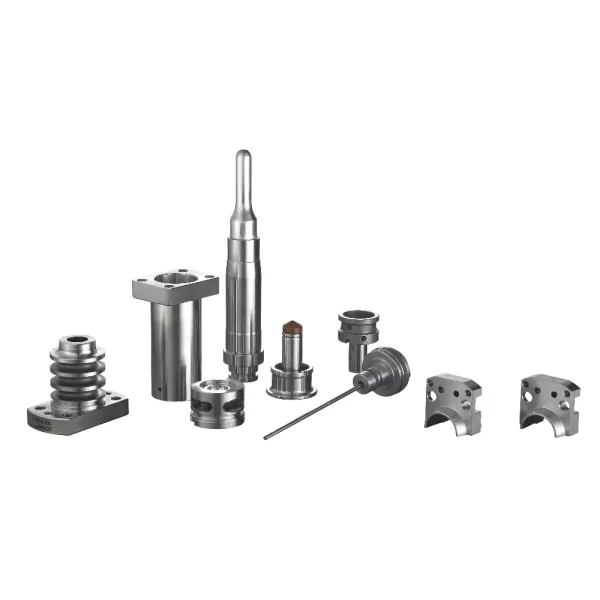
A great design well machined makes a great mould. Custom moulds manufacture involves multi-axis CNC milling, wire EDM and die-sink EDM. CNC machines can cut to +-0.005 mm when set up correctly. EDM can be used to reach tight corners and deep cavities that CNC cannot reach. Custom blow moulding and custom base moulding tooling usually needs both methods. Final size depends on cutting speed, tool type and feed rate. Good results are a product of good operators and good machines.
Machining Method Comparison
| Method | Best For | Tolerance Range | Surface Finish | Advantages | Disadvantages |
| CNC Milling | Large cavities, outer shapes | ±0.01 – ±0.02 mm | Ra 0.8 – Ra 1.6 | Fast and flexible | Not great for deep features |
| Wire EDM | Thin slots, sharp corners | ±0.002 – ±0.005 mm | Ra 0.4 – Ra 0.8 | Very precise | Slow and costly |
| Die-Sink EDM | Deep cavities, complex shapes | ±0.005 – ±0.01 mm | Ra 0.2 – Ra 0.4 | Good for fine details | Electrode wears out |
| Grinding | Flat surfaces, parting lines | ±0.001 – ±0.003 mm | Ra 0.1 – Ra 0.2 | Best surface quality | Only for simple shapes |
CNC does a lot of the work. EDM and grinding finish the job to meet the tight tolerance requirements for custom plastic mould manufacturing.
Advantages and Disadvantages of Precision Machining
Advantages:
- Parts remain the same size over long production runs
- Less waste, less rework
- Compatible with many types of custom moulding plastics
- Creates complex shapes that other methods can’t
Disadvantages:
- More expensive to install precision equipment
- Takes more time than regular machining
- Needs trained operators and regular inspection.
- Hard materials make machining process difficult
How Does Calibration Ensure Custom Moulds Stay Within Tolerance Over Time?
Even the most perfect mould will go out of tolerance if it is not checked regularly. Calibration is measuring components , making adjustments and keeping everything within specifications . During a production run heat, pressure and cooling all vary. Each change can change part sizes a little bit. Custom moulds manufacturers match parts to the original design with CMM machines and optical scanners. This is especially important with custom PVC moulding which is extremely sensitive to heat. Proper calibration requires regular cleaning, polishing and checks for wear. Skip calibration and your mould will surely die, slowly.
Calibration Case Studies
| Case Study | Industry | Problem | Solution Used | Result |
| Medical device housing | Medical | Size drift after 5,000 cycles | CMM check + cooling fix | Back to ±0.02 mm |
| Automotive connector | Automotive | Warping on custom plastic mouldings | Temperature profile + gate fix | 90% less warp |
| Custom PVC moulding part | Construction | Surface sink marks | Cooling redesign + pressure tweak | Zero defects |
| Electronic enclosure | Electronics | Flash on parting line | Polish + clamp force adjust | Clean parts, no flash |
Calibration Process Steps
- Step 1: Measure first parts with CMM – first article inspection
- Step 2: Record all process parameters – temperature, pressure, cycle time
- Step 3: Monitor part sizes over time with Statistical Process Control (SPC)
- Step 4: Maintain a mould care routine—clean, polish and inspect for wear
- Step 5: Re-test after repair or setting change
Why Does Material Choice Affect Tight Tolerances in Custom Made Mouldings?
The plastic you pick makes all the difference. Some materials shrink a great deal. Some flare badly to heat. This affects the size of the last part. Selecting the correct material for your custom moulds is a critical first step.
Material Tolerance Guide for Custom Moulding Plastics
- ABS – shrinkage only 0.4-0.7%. Work with ease. Great for most custom moldings Nylon (PA66) – shrinkage 1.0 to 2.0%. Hold water . Requires dry storage and handling
- Polycarbonate (PC) – 0.5-0.7% shrinkage. Very stable. Good for medical and optical parts PVC – common in custom PVC moulding. Heat sensitive. Needs precise temperature control
- PEEK – only shrinks 0.5% Very powerful. Requires hot mould temperatures. Expensive Polypropylene (PP) – Custom blow moulding. Shrinkage 1.0-2.5%. So the cavity needs to be larger to compensate.
- Each material also requires different mould steel, cooling and surface finish. So material choice must come early in any custom moulding project.
Frequently Asked Questions
How close can a good custom mould get?
A good custom mould can achieve tolerances of ±0.01 mm to ±0.05 mm. The outcome is a function of the material, part geometry and mould quality. Its on track with regular checks.
- In hard materials like ABS and PC it is easier to hold tolerances.
- Thin walls and complex shapes are more difficult to control
- Constant calibration ensures tolerances over multiple cycles
What is the lead time for producing a custom plastic mould with tight tolerances?
It generally takes 4-10 weeks to build a precision custom plastic mould. Complex parts are more lengthy. More testing and calibration takes more time, but it also makes it more accurate.
- Simple single cavity moulds: 4-6 weeks
- Complex multi-cavity moulds: 8 – 12 weeks
- Full production delayed by 1-2 weeks for First Article Inspection
The difference between custom moulding and standard moulding?
Custom moulds made for your exact part. Standard moulding uses pre-made tools that may not be tight in tolerance. For parts that have to fit exactly, custom is better.
- Custom mould can give tighter tolerances and a better finish
- Standard moulds are initially cheaper, but can fail to meet spec
- For high volume precision parts, customisation is the smarter choice
Why do custom plastic mouldings sometimes change their tolerance after production has started?
The main causes are mould wear, material changes and setting drift. Well calibrated and well monitored systems can catch these problems early before they lead to losses.
- The primary reason for the slow size change is mould wear
- Slight changes in material batch can affect shrinkage
- Machine settings drift and need to be re-checked regularly
Conclusion
Smart design, precise machining, and ongoing calibration. Each subject is essential for best results. Get all three right and you get parts that work perfectly every time. The price of doing something wrong is always higher than the price of doing it right.
Huadian Mould Co., Ltd. if you need a reliable partner in this. They are very experienced in custom moulds, custom plastic mouldings, custom made mouldings and custom moulding plastics. They take care of everything from design to delivery. They deliver precise results you can count on.