


Ever wonder why one plastic bottle seals tight, while another leaks on the shelf? I’ve been in the PET packaging industry for 8 years and I’ve seen thousands of bottles destroyed every hour due to preform mold errors. Precision is the most essential part of a smart preform mold manufacturers.
This essay will define cavity accuracy, and why it is important. Learn how top preform mold manufacturers build molds that last for millions of shots. Topics will include hot-runner systems, material selection, and industrial case studies. By the end you will know good molds from fantastic.
What Is Precision in PET Preform Mold Making?
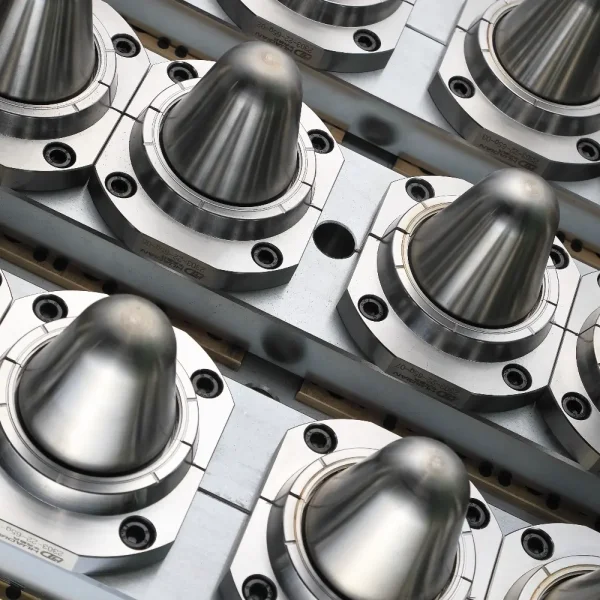
Precision mold manufacturing means everything fits just right. Pet preform mold manufacturers maintain ±0.02 mm tolerances. Any miscalculation of cavity size changes bottle wall thickness. This impacts the blow-molded bottle stretch. It also alters cap neck seal. Steel cores are cut with CNC machining and EDM grinding. All cavities in a multi-cavity mold are the same. If cavities are uniform, all preforms are identical. Quality preform mold manufacturers conduct rigorous quality checks at each stage.
How Does Cavity Count Affect Mold Performance and Output?
The number of cavities chosen is an important decision in mold design. The cavity count is determined by a preform blow molding manufacturer according to the client’s output. More cavities means more cycle output. More cavities require a more balanced hot runner system. Filling of the cavity more slowly gives thinner walls. This results in blow molding rejects. So cavity count and accuracy have to work together.
Single vs. Multi-Cavity Mold- Output & Defect Analysis
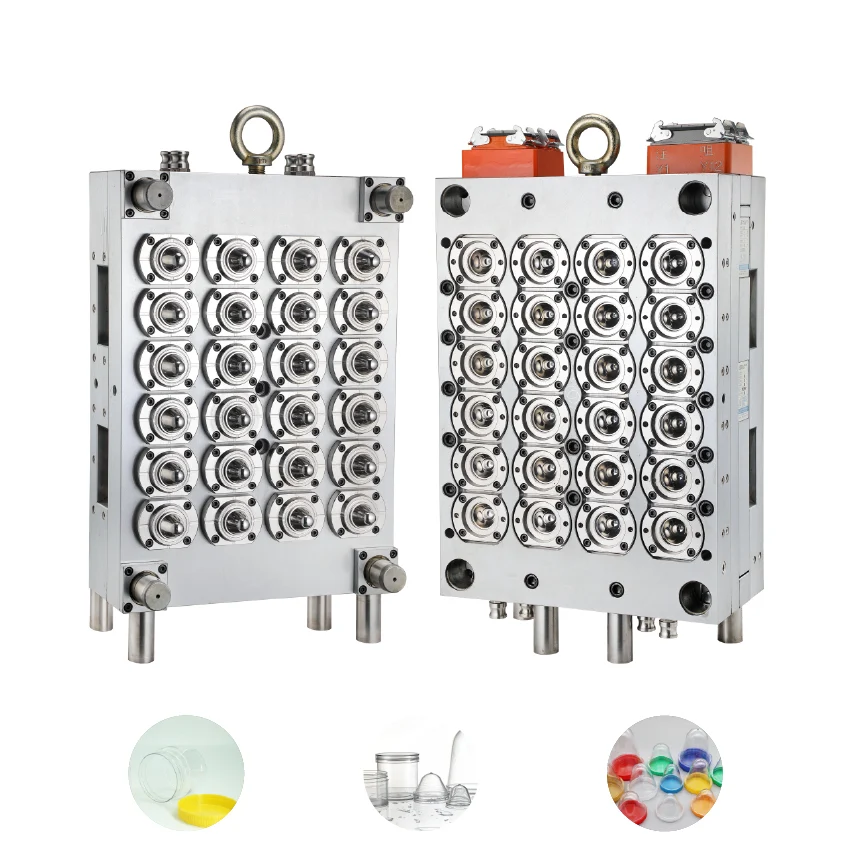
Single cavity molds are great for prototypes and small runs. Very easy to maintain and to debug. Mass production lines use 48 or 96-cavity molds. They require accurate cooling and runner balancing throughout the cavity. Preform mold manufacturers use simulation software to assess the fill balance before the steel is cut. This saves time and avoids costly mistakes.
Cavity Count vs. Output and Defect Rate Comparison Table
| Cavity Type | Output/Hour | Defect Rate | Best Use Case |
| Single-Cavity | 800–1,200 pcs | Very Low | Prototypes & trials |
| 16-Cavity | 12,000–18,000 pcs | Low | Mid-volume production |
| 48-Cavity | 40,000–55,000 pcs | Medium | High-volume beverage |
| 96-Cavity | 80,000+ pcs | Requires strict QC | Mass production lines |
The number of cavities is determined by production volume, budget and quality. More cavities mean higher productivity, but also more stringent process control. Always design mold to manufacturing objectives.
Key Factors That Influence Cavity Accuracy
- CNC machining tolerances determine the accuracy of the cavity to design drawings.
- Location of cooling channel determines cavity cooling after injection.
- Post-polish finish reduces friction, eases preform release.
- Maintenance and calibration keep cavities within spec over millions of cycles.
Why Do Hot Runner Systems Define Mold Reliability?
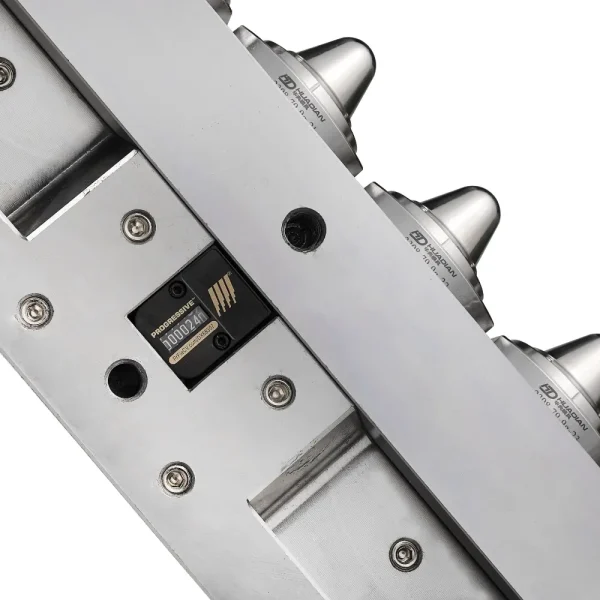
The plastic flows into the hot cavities by way of a hot runner system. This eliminates cold runners that waste raw material. Every hot runner preform mold manufacturer knows that the runner system must compress all gates equally. Cavity walls are of unequal thickness if pressure is unequal. This leads to machine downtime and rejections. A good hot-runner design shortens cycle times. Shorter cycle times mean more production per shift reducing bottle cost.
Hot Runner Gate Types vs. Mold Performance Benchmarks
| Hot Runner Type | Temperature Range | Gate Quality | Mold Compatibility |
| Open Gate | 220–280°C | Standard | Simple preform shapes |
| Valve Gate | 240–290°C | Superior | High-clarity PET |
| Sequential Gate | 250–295°C | Excellent | Multi-layer preforms |
| Insulated Runner | 200–260°C | Good | Low-cost tooling |
Mold Steel Selection- The Backbone of Long Life
Steel choice determines mold longevity. The softer steels wear out quickly. S136 hardened stainless steel can take 1.5 million bullets. The volume of production is typically the criteria serious preform mold manufacturers use to specify the steel grades. Use only H13 or S136 steel for high volume beverage operations. Heat treatment & surface coating improves mold life.
Mold Steel Types vs. Durability and Corrosion Resistance
| Material | Hardness (HRC) | Lifespan (shots) | Corrosion Resistance |
| P20 Steel | 28–34 HRC | 500,000+ | Moderate |
| H13 Steel | 46–52 HRC | 1,000,000+ | High |
| S136 Stainless | 48–52 HRC | 1,500,000+ | Excellent |
| 420SS Steel | 50–54 HRC | 2,000,000+ | Outstanding |
Steel selection affects mold life. 420SS and S136 are good for long run manufacturing. For lower quantities, P20 or H13 are more durable and affordable. Match steel quality to shot count.
Advantages and Disadvantages of Hot Runner Systems
- Benefit: 15% reduction in cold runner waste and raw PET material prices.
- Cold runner molds are obsolete: 20% faster cycle time.
- Con: Professional setup, temperature calibration before production.
- Disadvantage: More expensive tooling than cold runner molds.
How Do New Product Molds Deliver Reliability Across Sectors?
Each new product needs a good mold in the first place. A new product preform mold maker must accommodate unique shapes, neck finish and wall profiles. A good mold will give you the same thing every time. After 100,000 or 1,000,000 rounds, the performance cannot be changed. The pharmaceutical and food packaging industries need a defect-free output. This is why preform mold manufacturers do a lot of trial testing before sending any mold to the customer.
Industry Case Studies- Precision Molds in Action
| Industry | Application | Cavity Count | Output Gain | Result |
| Beverages | Water bottles | 96-cavity | +35% | Cost cut by 22% |
| Pharma | Medicine bottles | 32-cavity | +28% | Zero leakage |
| Cosmetics | Serum containers | 24-cavity | +20% | Zero rejects |
| Food & Sauce | Condiment jars | 48-cavity | +30% | Seal pass rate 100% |
Precision Mold Advantages and Limitations by Feature
| Precision Feature | Advantage | Limitation | Mitigation Strategy |
| Tight tolerances | Better part quality | Higher tooling cost | Long-term ROI offsets cost |
| Multi-cavity design | Mass output volume | Complex maintenance | Scheduled servicing plans |
| Hot runner system | Zero material waste | Needs expert setup | Factory training support |
| Hardened steel cores | 2M+ shot lifespan | Heavier mold weight | Optimized mold frames |
Sectors That Rely on High-Precision Preform Molds
- Beverage industry: High speed tamper proof caps require consistent neck finish.
- Pharmaceutical industry: Need for clean-room compatible mold surfaces.
- Cosmetics market:Requires a perfect surface finish and precise dimensions.
- Steel must be FDA-approved for food packaging, gates must be secured, and seals must be air-tight.
Frequently Asked Questions
What tolerance should the good preform mold have?
A good mold can hold tolerances of +/- 0.02 to 0.05 mm on all critical dimensions. This makes sure the right wall thickness and neck finish on all parts.
Tighter tolerances and better blow molding consistency.
Precision CNC and EDM grinding
Cavities are within spec after routine inspection.
Why choose a hot runner mold over a cold runner mold?
Hot runner molds minimize waste and cycle time. They are ideal for high volume manufacturing where every second and gram of PET is critical.
Cleaner manufacturing, no sprue or runner trimming.
Energy saving due to constant melt temperature of manifold.
Gate quality is superb, especially with valve gate systems.
Why is it important to balance multi-cavity mold cavity?
With cavity balancing, each cavity fills at the same pressure and rate. Blow-molding rejects are caused by unbalanced pieces.
Balance is verified by flow simulation software before mold construction.
Balanced hot runners melt all gates the same
Pressure testing for long runs to ensure equilibrium.
Which industries use precision preform molds the most?
Accurate molds are required for pharmaceutical, beverage, cosmetic and food packaging. Molds have to be precise in each area to meet quality and safety criteria.
Beverage equipment needs fast cycles without neck leakage.
Pharma requires sterile surfaces and no particulates.
Cosmetics must be optically clear and of uniform dimensions.
Can I use the same model for different bottles?
Molds are designed for a particular preform weight and neck size. Changing bottle size typically requires a new mold or extensive core and cavity retooling.
Interchangeable insert systems for small size variations without retooling.
New core and cavity parts are always needed for neck finish changes.
“Ask your provider before assuming a mold is multi-purpose.
How can I verify the quality of a preform mold manufacturer?
Before purchase, please request for ISO certification, factory audit and sample preforms from preform mold manufacturers. Check their test procedures, steel material certifications, and trial run records.
Availability of cavity dimension inspection reports and measurements.
The video on mold testing should show the same output in all cavities.
Ask about after sale support & spare parts.
Conclusion
Every pet preform mold manufacturers takes accuracy seriously, giving their clients a competitive advantage. It’s all about the details, from cavity precision to hot runner balance and the choice of steel. During years of production, ideal molds are differentiated from worse ones by reject rates, cycle times and total output. The right mold partner is one of the best investments a bottling or packaging company can make.
Huadian Mould Co., Ltd. has decades of experience designing and making precision molds for the world market and is a well-established, high quality pet preform mold manufacturer. Molds for drinks and medications are made to very tight tolerances. Huadian molds leverage in-house CNC machining, hot-runners expertise and strict QC processes for longer runs, cleaner preforms and lower per-unit costs.